
Search Texas Warrant Records
Texas warrant records are public documents. Courts create them to order an arrest or a search of a person or place. You can look up active warrants through the Texas Department of Public Safety, county sheriff offices, and court clerks across all 254 counties. Some counties post warrant lists online. Others need a phone call or an in-person visit. The DPS Crime Records Division runs a statewide criminal history search tool that is open to the public. Local sheriff offices can also check for active warrants in their area. No single source holds every Texas warrant record, so a thorough search may take more than one step.
Texas Warrant Records Overview
Where to Find Texas Warrant Records
The Texas Department of Public Safety is the main state agency for criminal history and warrant data. DPS runs the Computerized Criminal History System, known as the CCH. This system stores arrest records, case outcomes, and warrant information from law enforcement agencies across Texas. The Texas Crime Information Center operates 24 hours a day, 7 days a week. It gives officers real-time access to warrant status, stolen property data, and missing persons alerts. For the general public, DPS offers a name-based search through the Crime Records Division. You can run it online or send a request by mail.
The Texas DPS portal shown below is the starting point for statewide warrant records and criminal history searches.

From this site you can reach most wanted lists, the sex offender registry, and the Crime Records Division page.
The Crime Records Division handles public criminal history requests. Each online search costs $3.00. You set up a CRS Public Website Account and buy search credits. Credits do not expire. Written requests by mail cost $10.00. Send them to DPS Crime Records Division, PO Box 4143, Austin, TX 78765-4143. As required by Texas Government Code Section 411.135, the data returned reflects only convictions and deferred adjudications. If a name search finds fewer than fifteen matches, DPS sends all of them. More matches and they ask for more details to narrow it down. Call 1-855-481-7070 for help.
Below is the Crime Records information page with details on search fees and request methods.
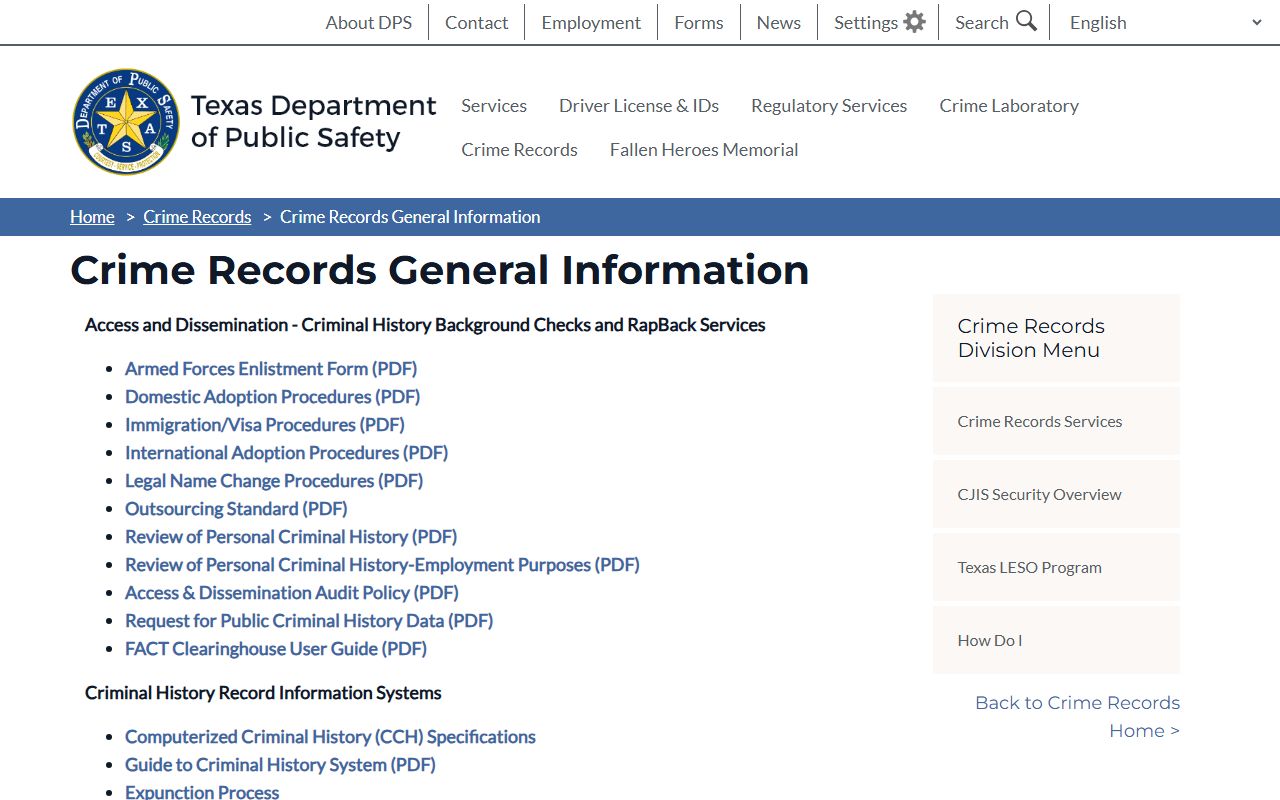
This page walks you through both online and mail-in request options for Texas criminal history data.
Note: DPS criminal history searches cover convictions and deferred adjudications only, not every active warrant from every court in Texas.
How to Search Warrants Online
The DPS Criminal History Name Search is the main public tool for searching conviction records in Texas. You search by first name, last name, and date of birth. Each search uses one credit. The system pulls data from the CCH and shows arrest offense levels, degree of offense, court referrals, and fine information. You need a CRS account to use it. Payment is by check or credit card. Credit card orders include a $0.25 fee plus 2.5% of the total. Search credits last until you use them all.
To run a warrant-related search you typically need:
- Full name of the person
- City or county where the warrant was issued
- Approximate age or date of birth
- Partial info works but may return extra matches
The Texas Department of Criminal Justice has its own offender search tool. It shows inmate records going back to 1978. You can search by TDCJ number, SID number, or name. Results include date of birth, race, gender, projected release date, and current facility. TDCJ also posts the Texas Most Wanted Fugitives list each month. Crime Stoppers pays up to $5,000 for tips that lead to an arrest. Call 1-800-252-TIPS or submit a tip through the DPS website.
The TDCJ website shown here provides offender searches and fugitive warrant details.

Click on any name in the search results to see full offense history, parole status, and visitation info.
The Texas Public Sex Offender Registry is another searchable tool run by DPS. Under Chapter 62 of the Code of Criminal Procedure, all convicted sex offenders must register with local law enforcement. The registry lets you search by name, address, county, or zip code. It shows photos, addresses, and offense details. Registered offenders must report changes within 7 days. Failure to register is a felony in Texas. The registry includes maps to show offender locations in a given area.
Below is the DPS sex offender registry search page.
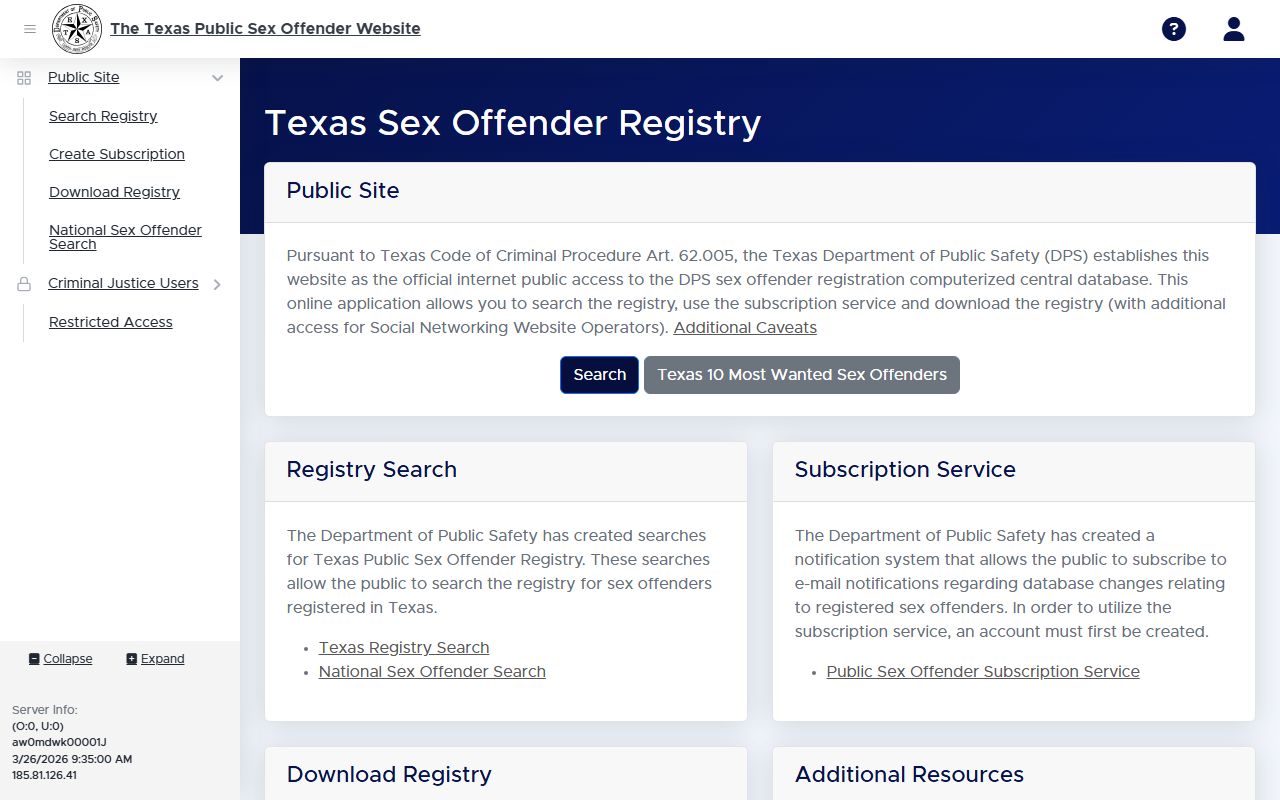
Anyone can use this tool for public safety purposes at no cost.
Texas Court System and Warrants
Texas has five levels of courts. At the first level are Justice Courts and Municipal Courts. They handle small claims, city ordinance cases, and Class C misdemeanors. Both types can issue warrants and serve as magistrate courts. Next come the County Courts. Constitutional County Courts deal with probate, civil matters up to $10,000, and more serious misdemeanor cases. County Courts at Law have broader reach. They handle civil cases up to $100,000 plus criminal appeals.
District Courts sit above the county level. They handle all felony cases, land title disputes, and family law matters. Most felony arrest warrants come from this level. At the top are 14 Courts of Appeals, the Supreme Court of Texas for civil cases, and the Court of Criminal Appeals for criminal matters. Each county has a District Clerk who keeps felony records and a County Clerk for misdemeanor files. The clerk of the court is the custodian of warrant records and case files at each level. You can visit the Texas Judicial Branch website for an interactive map of all 254 county court systems.
The Texas Judicial Branch site shown below provides a county directory and court records access information.

Use this site to find the clerk office, phone number, and address for any Texas county court.
The Texas Commission on Law Enforcement licenses every peace officer in the state. TCOLE sets training standards for warrant service and high-risk operations. In September 2024, TCOLE launched a Public License Lookup tool. You can search by name, TCOLE ID, or agency. It shows license status, training records, and issue dates. Under the Texas Occupations Code, TCOLE has oversight over officer complaints tied to criminal conduct or licensing violations.
The TCOLE website is shown below with the officer license lookup and training records portal.

This tool lets anyone check the credentials and training history of a Texas peace officer.
Types of Warrants in Texas
Under Article 15.01 of the Code of Criminal Procedure, a warrant of arrest is a written order from a magistrate. It tells a peace officer to take a person into custody. The warrant must name the accused or give a clear description. It must state the offense, the time and place it happened, and carry the signature of a magistrate. Under Article 15.06, any arrest warrant extends to every part of the state. A peace officer can execute it in any Texas county. Under Article 15.23, an arrest may happen on any day or at any time, including holidays.
Bench warrants are issued when someone fails to show up for court. These are common with missed traffic court dates and skipped hearings. Capias warrants come after a grand jury returns an indictment. The court issues a capias to bring the defendant in. Search warrants let officers look through a specific place for evidence. Under Article 15.04, a written complaint from a credible person must come before a magistrate can issue any arrest warrant. Article 15.17 says the magistrate must tell the arrested person about the charges, their right to a lawyer, and their right to stay silent.
The official Texas statutes page for Chapter 15 of the Code of Criminal Procedure is shown below.
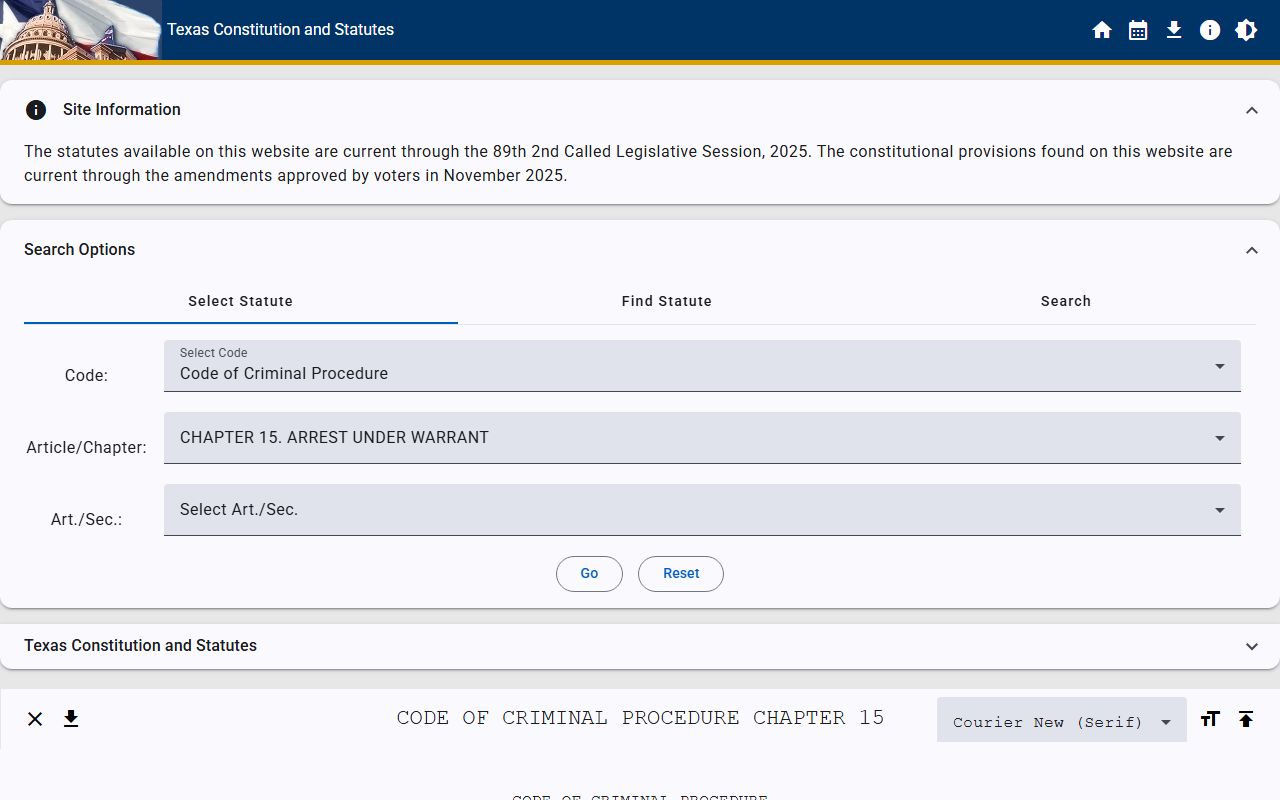
This chapter covers every aspect of arrest under warrant in the state of Texas.
Warrant records list the type of warrant, the charges, the issuing court, and bond amounts when set. Some counties publish active warrant lists on their sheriff's website. Others require a phone call or in-person visit. The Justia legal library also provides the full text of Chapter 15 for reference.
Below is the Chapter 15 text as shown on Justia, a legal research resource.
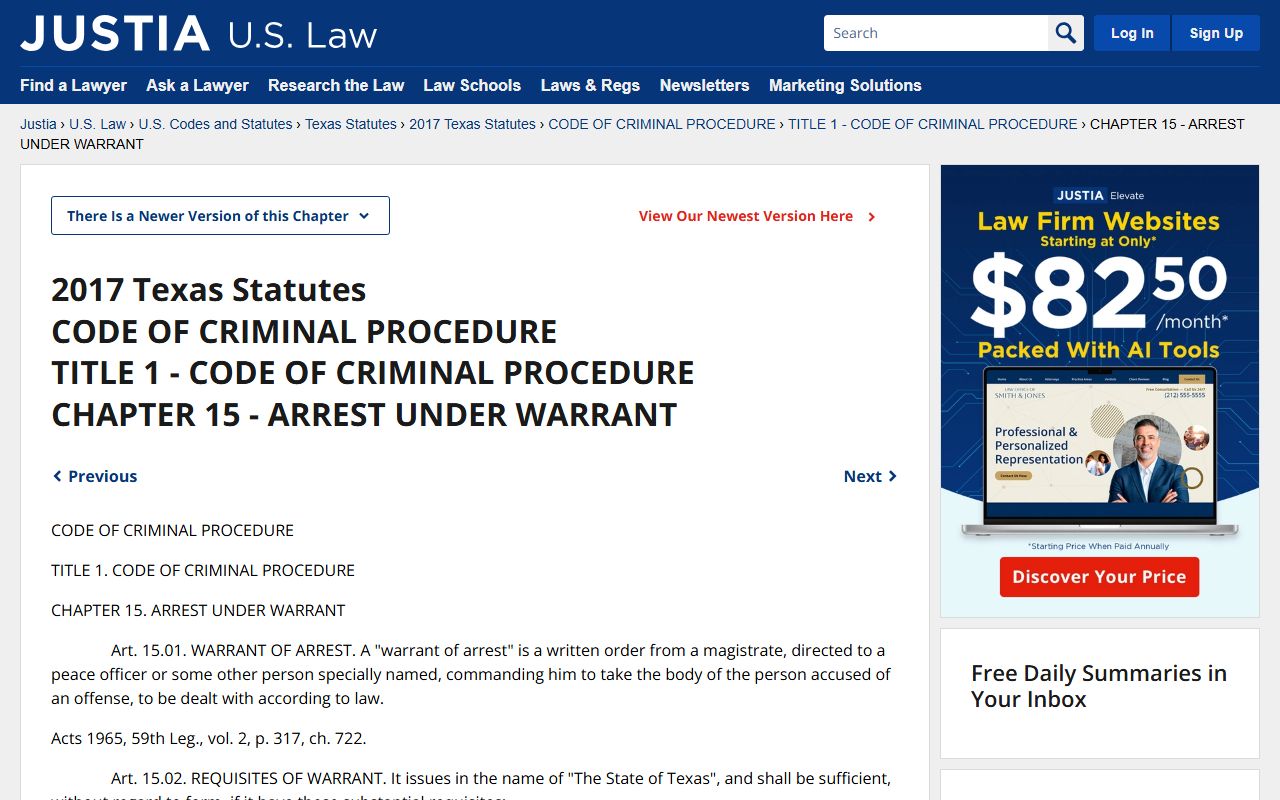
Both the official statutes site and Justia carry the same legal text for public use.
Public Access to Warrant Records
The Texas Public Information Act is in Government Code Chapter 552. It gives the public the right to access government records. Warrant records are generally public. Section 552.021 says information is public if it was produced, collected, or maintained by a governmental body. You do not need a reason to ask for records. The law applies to all government bodies in Texas, from state agencies to counties to cities.
Some exceptions do apply. Under Section 552.108, law enforcement can withhold records that would interfere with a criminal investigation or put someone in danger. Section 552.107 protects attorney work product tied to pending cases. But once a case is no longer active, those limits often go away. Agencies must respond within 10 business days. If the cost to produce records goes over $40, they have to give you an estimate first. Call the Attorney General's Public Information Act hotline at 512-478-6736 for questions. The toll-free number is 1-877-673-6839.
The Texas Attorney General's website is shown below with public records guidance and model request forms.

The AG's office rules on disputes between the public and government bodies over records access.
Under Section 552.353, an official who knowingly withholds public records faces criminal penalties. The law is clear that government transparency is not optional. Most warrant records fall squarely in the public category. If a records request is denied, the AG's office can order the release of the documents.
The full text of Government Code Chapter 552 is shown below.
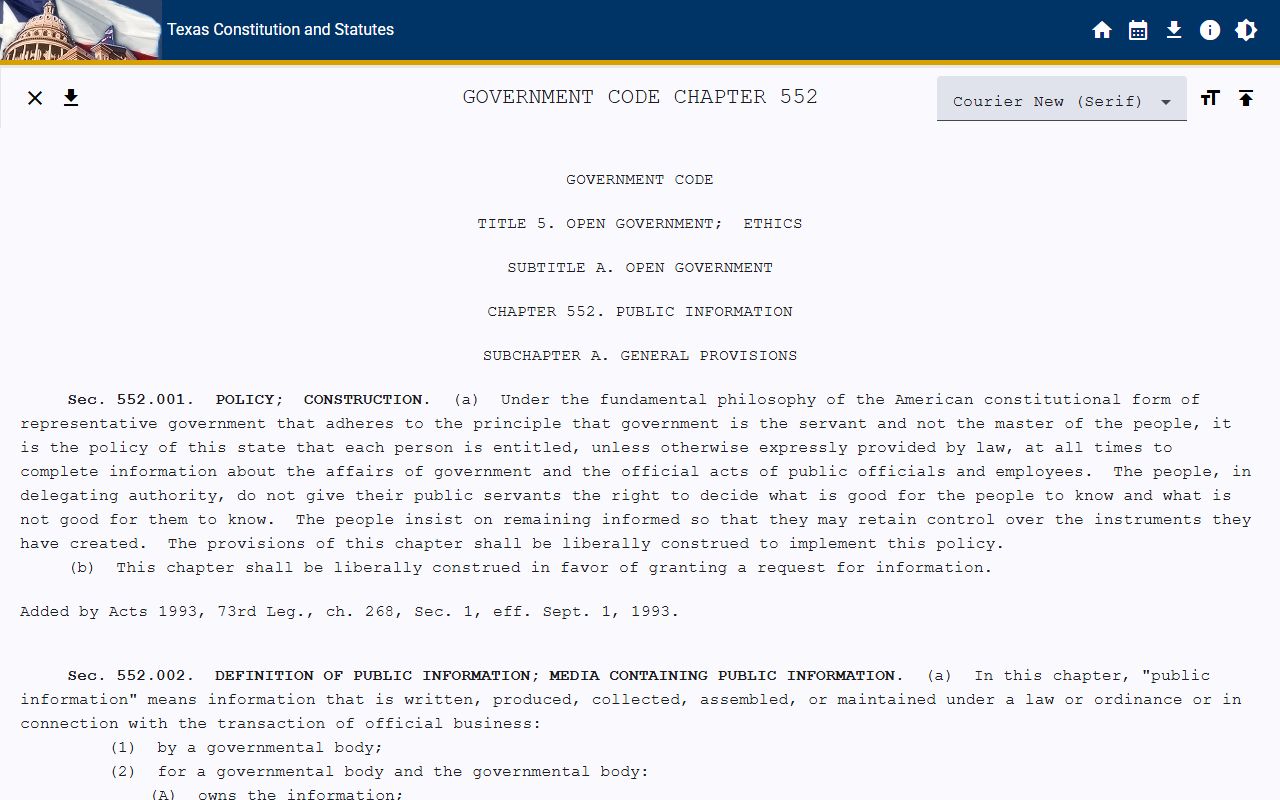
This chapter defines what counts as public information and how Texans can request government records.
Note: Most Texas warrant records are public, but records tied to active investigations or sealed by a judge may have limited access.
Texas Most Wanted Fugitives
The Texas DPS keeps a list of the 10 Most Wanted Fugitives. These are people with active warrants who pose the highest risk. The list is updated each month. Each entry includes a photo, physical description, known associates, and warrant details. Blue Alerts work like AMBER Alerts. They go out on phones and highway signs when a violent criminal has hurt or killed a law enforcement officer. The goal is a fast capture.
Texas Crime Stoppers operates across the state. Tips can be called in at 1-800-252-TIPS. You can also submit them through the DPS website or on Facebook. All tips are anonymous. Rewards go up to $5,000 for information that leads to an arrest. Many counties and cities run their own Crime Stoppers programs too. These local programs give people another way to report wanted persons with active warrants in their community.
Browse Texas Warrant Records by County
Each of Texas's 254 counties has its own sheriff's office and court system that handles warrant records. Pick a county below to find local contacts, search tools, and resources.
Warrant Records in Major Texas Cities
Residents of major Texas cities can check warrant records through their county court system or local police department. Pick a city below to find where to search.