
Hidalgo County Warrant Records
Hidalgo County warrant records are managed by the Sheriff's Office and court clerks in Edinburg, Texas. This is one of the largest counties in South Texas, sitting along the Mexican border in the Rio Grande Valley. The County Clerk holds misdemeanor case files and the District Clerk manages felony records across multiple judicial district courts. Active warrants are tracked by the Sheriff's Office. You can search for open warrants by phone, in person at the courthouse, or through Texas DPS online tools. Warrant data is public under state law and can be pulled up by name or case number at any of the local offices.
Hidalgo County Overview
Hidalgo County Sheriff Warrant Division
The Hidalgo County Sheriff's Office keeps all active warrants issued by local courts. They handle warrant checks for the public and for other law enforcement agencies. You can call 956-318-2200 to ask about a warrant. The office is in Edinburg and accepts walk-ins during regular business hours, Monday through Friday.
Warrant records from Hidalgo County include the defendant's name, charges filed, bond amount, the court that put the warrant out, and the warrant status. Active, served, and recalled warrants are all tracked. The Sheriff's Office executes criminal warrants and coordinates with other agencies across the Rio Grande Valley and beyond. When someone with a Hidalgo County warrant gets picked up in a different county or state, extradition rules apply. The office also handles fugitive apprehension and works with federal agencies given the county's border location.
All warrant information is public under Texas Government Code Chapter 552.
Searching Hidalgo County Warrant Records
Call the Sheriff's Office first. Have a full name ready. A date of birth makes the search more precise. You can also go to the courthouse in Edinburg and ask the clerk to look up records by name or case number.
The Texas DPS Criminal History portal offers statewide name searches that include Hidalgo County. A small fee applies for the online check. The DPS Crime Records page has details on how to run a search and what results to expect.
Hidalgo County has an unusually large number of district courts. The District Clerk stores felony records from the 92nd, 93rd, 139th, 206th, 275th, 370th, 389th, 398th, 430th, and 476th Judicial District Courts. That is ten district courts, which reflects the county's large population. The County Clerk handles misdemeanor records, civil cases, and probate. Standard copies cost $1.00 per page at both offices.
Hidalgo County Warrant Types
Warrants come from multiple court levels in Hidalgo County. Felony arrest warrants are issued by the District Courts. Misdemeanor warrants come from the County Court. Justice of the Peace courts handle Class C misdemeanor warrants for traffic tickets, code violations, and other minor offenses.
Each warrant must meet the rules in Chapter 15 of the Texas Code of Criminal Procedure. A magistrate signs the warrant based on probable cause. It names the person and describes the offense. Once active, any peace officer in Texas can serve it. The Hidalgo County District Attorney prosecutes all felony cases and works with law enforcement on investigations. The County Attorney handles misdemeanor prosecution, juvenile cases, and provides legal counsel to the county.
Criminal case records include charging instruments, plea agreements, trial transcripts, sentencing orders, and all motions filed. The District Clerk maintains an index of every felony case. Some records may be accessible through the Texas e-Filing system.
Note: With ten district courts, Hidalgo County handles a very high volume of felony cases compared to most Texas counties.
Constable and JP Courts in Hidalgo County
Hidalgo County has multiple constable precincts. Each covers a different part of this large county. The constables serve civil process and execute criminal warrants within their precinct areas. They handle citations, subpoenas, protective orders, and eviction notices.
The Justice of the Peace courts deal with Class C misdemeanor cases, civil claims under $10,000, and truancy matters. JP courts issue arrest warrants for minor offenses, hold initial hearings, and set bonds. Warrants from JP courts cover traffic citations, ordinance violations, and school attendance issues. Each precinct has a constable who serves these warrants. The constable and Sheriff's Office coordinate to keep warrant records current across the entire county.
State Search Tools for Hidalgo County
The Texas Department of Public Safety runs the main state criminal records database. The Texas Department of Criminal Justice tracks current and past inmates. The Office of Court Administration oversees courts across Texas and can direct you to the right records.
The Texas Attorney General's Office processes public information requests and runs victim notification. These tools are valuable when you need to search across multiple counties or when you want to avoid traveling to Edinburg. The statewide databases pull from all 254 counties, giving a full picture of someone's criminal history. For the most detailed local records, the Hidalgo County courthouse remains the primary source.
Clearing Warrants in Hidalgo County
If you have a warrant in Hidalgo County, you can clear it by posting bond at the courthouse in Edinburg. Bond amounts vary by charge. Felony bonds are set by the district court judge. Misdemeanor bonds come from the county court. Class C bonds are set by the JP court. Cash bonds, surety bonds, and personal recognizance bonds are all possible depending on the case.
You can also turn yourself in at the Hidalgo County jail. The booking process includes seeing a magistrate who reads the charges and sets bond if needed. Once you post bond, the court gives you a date to appear. The warrant status then changes from active to served in both the Sheriff's records and the clerk files. Given the high volume of cases in Hidalgo County, the jail can be busy, so expect some wait time during the booking process.
Cities in Hidalgo County
Hidalgo County has several large cities in the Rio Grande Valley. Warrant records for offenses in these cities flow through the Hidalgo County courts and Sheriff's Office.
Nearby Counties
These counties border Hidalgo County in the Rio Grande Valley. Warrants are filed in the county where the charge was brought.
The screenshot below shows the Texas Code of Criminal Procedure Chapter 15 page, which outlines the rules for arrest warrants that apply in Hidalgo County.
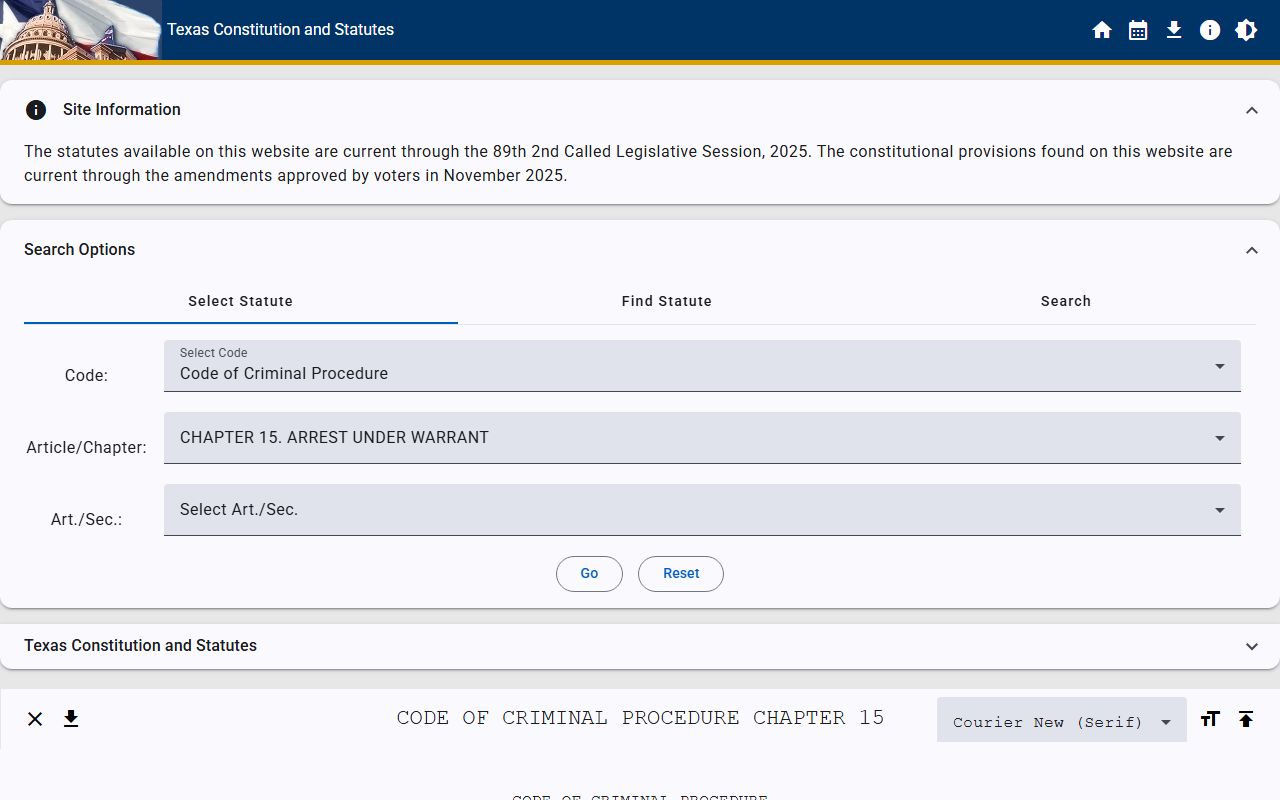
This statute governs how warrants are issued and served in Hidalgo County and every other county in Texas.